
Alexia Fiasco
memos on difference

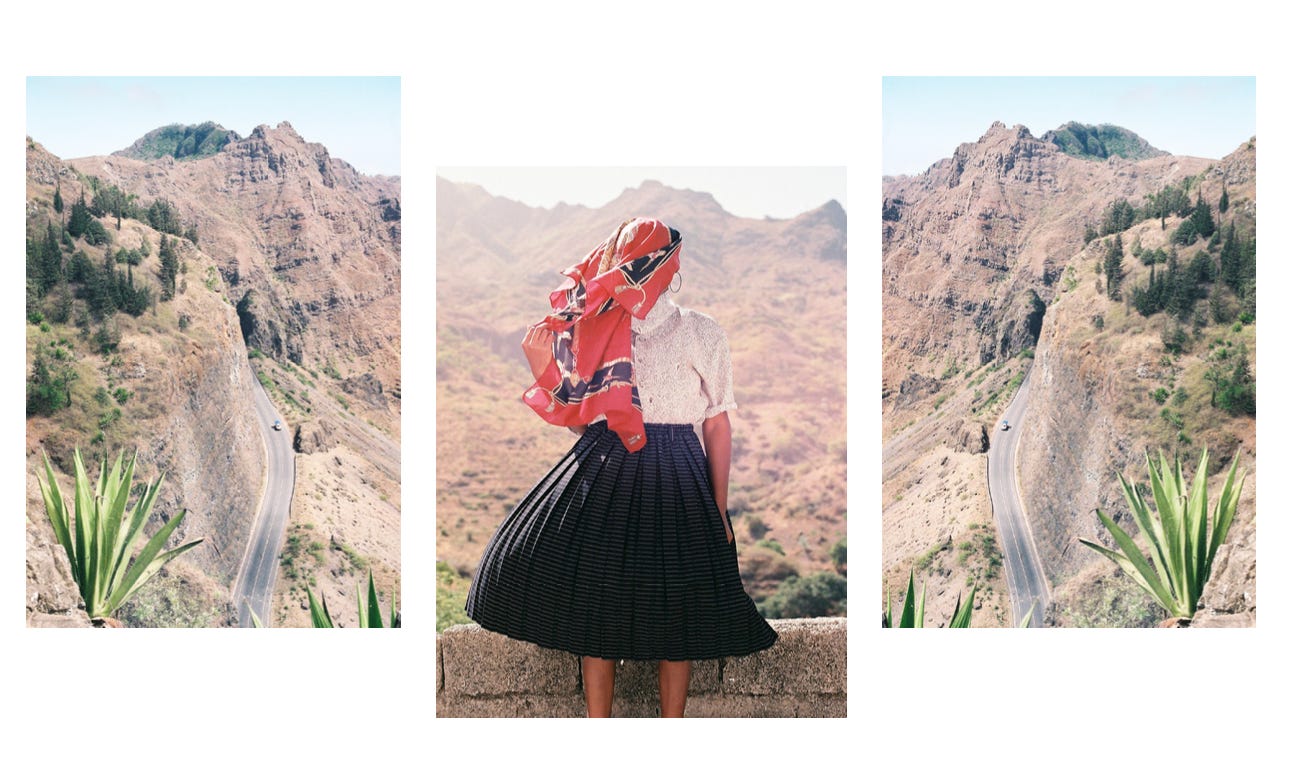
Alexia Fiasco, Nelida and the Serra Malagueta, Santiago Island, Cape Verde, 2018
3.
i left home permanently in 2017, after spending most of my life between the small towns of Modakeke and Ile-Ife in Osun state. conceived as an act of independence and self-determination, i would not see my parents for the next three years. a deliberate if somewhat ill-advised decision. during my time away, i received a request from my father for an image of myself that would be used in creating a family photograph — the type often displayed proudly in living rooms. i assumed the logic was that if i couldn’t be physically present, a trace of my existence would suffice. the photograph was to become a testament to my wellness and a partaking of continuity and rootedness. dad-mum-sister-me-sister. an unbroken link of relation.
i never got around to sending a photograph.
i went back home for a brief visit in 2021, due partly to my parent's insistence and as an attempt to bridge the distance that was already beginning to form.
i begin with this story because i am looking at a series of images from Alexia Fiasco’s photographic series ‘The Denial’. each of the images in this body of work represents a longing and an invention. a story of a return to the barely visible traces of the past and a fictive attempt at reconciliation. we read these images as both fiction and documentary, traces of an existing root and a speculative family archive.
born to an immigrant father from Cape Verde and a part Guadeloupe, part French mother, Alexia Fiasco grew up in the Parisian suburbs of Seine-Saint-Denis. she attended high school in Courbevoie, Hauts-de-Seine referring to it as a “town that had nothing to do with where I lived” and a “constant back and forth between two worlds and the feeling of not belonging to either of them”. this historical and physical separateness from place would go on to influence a large part of Fiasco’s practice as a photographer and social worker.
in 2017, she embarked on a journey to Cape Verde after several unsuccessful attempts to learn more about her paternal history from her father who left the island for France when he was 13. the resulting work from this trip is a fictional family album created from a retelling of family stories and history. we are introduced to Anna, the artist’s grandmother, Manuel, her grandfather, Pedro her father, Gina her aunt, Pascale her mother, and a cousin Maria-Jesus, all imagined representations of real personalities.
the photographs in this series bear little resemblance to conventional images in family archives and albums. each figure is shown independently, presenting no link between a person/event and the next. what makes these images striking as a ‘family album’ isn’t necessarily in the intimate, familial relationship between bodies, but an overwhelming experience of place and absence. each photograph carries with it a sense of departure and a longing for the departed.
a series of three images presented as one is open before me. in the central panel, a woman is captured facing the camera, her body turned towards us. a vibrant red scarf covers her entire face, allowing only a glimpse of a single hoop earring delicately hanging at its edge. her right arm, slightly raised as if beckoning is partly concealed amid the folds of the scarf. the immediate sense of distance we might feel from this image — primarily in the obscuring of her face — is echoed in the expansive plains and distant hills that frame the figure. on either side of the middle panel are mirrored images of a mountain range with a road cutting a path into a shadowy passage, presumably a tunnel through the mountains. a lone vehicle is seen coming down the road; i imagine just emerged from the tunnel.
the visual similarity between the curve of the road and the billowing skirt of the woman establishes a rhythm of movement, particularly the process of journeying. three narrative captions accompany this image. one identifies the woman as ‘GINA, MY AUNT, CRYING WOMAN, 1986’, another gives us even more information ‘Daughter of one of Manuel’s other «co-wives», at the age of ten, she is the first to know that my father is about to leave for Europe. She tells me that she cried for days and was left without any news for several years. At 20, she will go find her brother’. The last caption reads ‘Nelida and the Serra Malagueta, Santiago Island, Cape Verde, 2018’.
we often speak about the sense of loss and displacement of home felt by the itinerant and newly arrived, a loss of familiar street names, faces, bodies, architecture and language. we create textures and myths of place through the subtle unfolding relation of self and setting. i understand where i am from by the long, winding dirt road that leads from the expressway to my mother’s house, by the people i stop to greet on my walk home, by my father’s complaints about my lack of faith.
over the years from its invention to mass production, photography (especially within private use) has been useful in establishing connections between bodies and places, a way to affirm (continued) presence and links of existence. however, the images in ‘The Denial’ remind me of John Berger’s assertion that the ‘most popular use of the photograph is as a memento of the absent’. Fiasco’s images allude to a perceived absence as much as they present us with intimate lives. she makes temporal leaps — from 1986 to 2018, another from 2027 to 2018 — simultaneously inventing past and future archives from the margins of familial and social history.
the creation of a collective, intimate imaging is central to Faisco’s current practice. where the images in ‘The Denial’ invent a fictional family archive, her ongoing series ‘ADN’ examine differing responses to place and assimilation between immigrant parents and their children. as if in response to the images in ‘The Denial’, the photographs in ‘ADN’ draw from the compositional aesthetics of traditional family albums in presenting a contemporary post-colonial and migratory imagery of kinship — biological and adoptive.
here, the relation of bodies is evident. also evident are shifting states of belonging. a mother, Fatima is described as ‘Moroccan, born in Morocco’; her son, Jamal as ‘Turkish-Moroccan, born in France’. Fiasco’s detailed captioning acknowledges the various complexities and diverse spheres of identities that arise from movement between borders. she presents these images as a contemporary record of difference, noting ‘I want to create an honest and contemporary post-colonial archive that would show the diversity within our very families. With its questions, its doubts, its weaknesses but above all its strengths. I want to create images that I wish I had grown up with’.
perhaps Fiasco’s desire to bridge the distance and sense of loss between displaced bodies through the family album is echoed in my father’s request for a photograph. the family photograph establishes a relational link between distinct identities and generations. a body is defined by her relationship with other bodies in the photograph. it is from this mutual acknowledgement of one another — in the way a son’s palm rests gently on the father’s shoulders; in the father's seemingly permanent scowl; in the tender touch of a son's face against his mother's head — that we begin to tease out individual identities. what aspects of their character do their poses and individual style give away? what is each person’s contribution to the physical and social qualities of the photograph?
while there is an evident link and sense of intimacy between the figures in ADN — even from the more formal, frontal portraits —the project also examines the varying social concerns and expression between different generations of immigrants. in our conversation, Fiasco speaks on the issue of assimilation, noting the desire of the older generation to be integrated into the unified whole versus the emphasis of a younger generation on a definition through difference. these shifting concerns in ideology/expressions transform the idea of the family album into a hybrid, contested state; a scene through which evolving family histories can be read and imagined.
this attempt at reading and producing the family archive forms a significant aspect of Fiasco’s practice. from the fictive to the real, her work creates what Glissant refers to as an imaginary; a realm of possibilities where multiple perspectives and ways of knowledge coexist. placed within the context of the increased exodus of young people from African countries, the family album as a tool of the imaginary becomes useful in bridging the loss ultimately experienced in the aftermath of departure. real or imagined, biological or adoptive, the production of the family archive creates a space to experience one another across distances (physical and ideological) and times.
Love how this writing started. The context is relatable and causes one to reflect❤️