
Ugochukwu Emebiriodo - Take Me With You
memos on difference

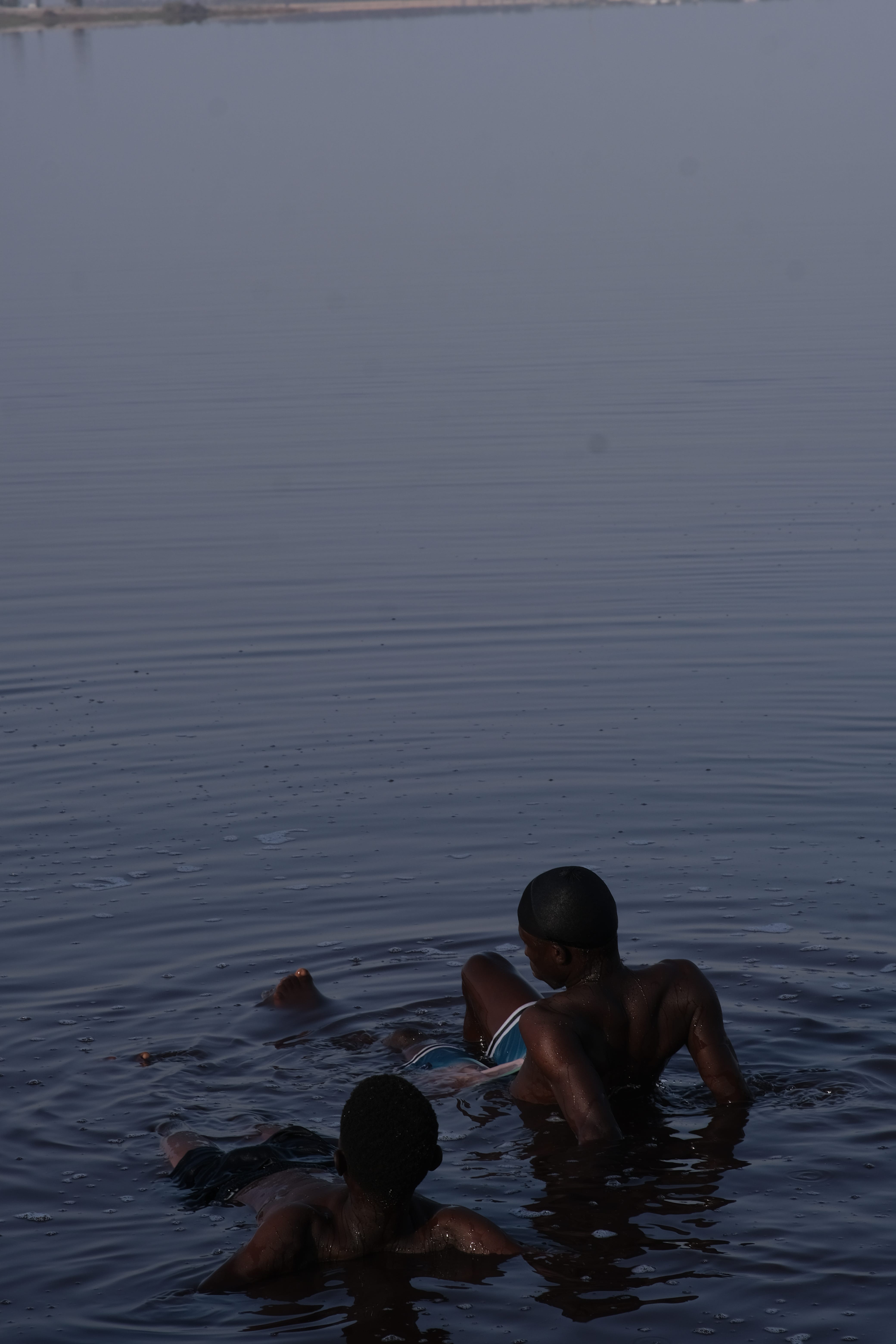
Ugochukwu Emebiriodo, Untitled (Take Me With You), 2022
4.
i remember him recounting an ordeal at the border in Ghana during one of his travels. we were at a mutual friend’s exhibition at Alliance Française in Lagos. i remember my disbelief and the increasing dismay i felt as he narrated his experience of being detained by immigration officials at Aflao just because he possessed a Nigerian passport. i imagine his attempts at explaining that he was a photographer interested in documenting events and peoples across African cities and the disdain with which he was responded to.
this experience despite its sad nature is not unfamiliar. a couple of years ago, i had read of a similar experience by a group of writers, filmmakers and photographers during their travels across parts of Africa. an experience of dehumanisation that comes with having the wrong passport.
this text however is not about this event or similar ones, but about the work produced in spite of it. presenting responses (shown in italics) from a conversation with the artist as well as personal musings on these responses, the dialogue here is in part an account of the travels of Nigerian photographer Ugochukwu ‘Hitch’ Emebiriodo and an address to the errant. the body constantly moving through the margins and interstices of place.
I had originally started off travelling before I became a photographer, I was travelling and I had a camera so it became a thing where I started to actively document those experiences. Before I started, I would google places I wanted to go to and wouldn’t see images that justified those spaces. If I found anything, they’d come with tags like Getty images with some white photographer's name and that didn’t make any sense, to be honest. When I started to travel, it began to make sense because the people who have access are people with certain passports. Travelling within the continent comes with a lot of restrictions; borders are often closed without proper announcements. There are times you get to the border and are treated a different way even if you have a justifiable reason for being in the country.
the photographs Hitch sends me bear no traces of this tragedy. it is only recounted in the occasional story. the images of festivals, traders by the sea, a dense motor park are organised in a folder titled ‘Take Me With You’, a sentiment i remember expressing to him a while ago. an almost child-like request to accompany the traveller on his journey. the child eagerly looks to the adult as he prepares to head out. ‘take me with you’. a plea and an offering of trust. a desire to set out into the unknown in the company of the experienced traveller, giddy with the prospect of adventure. these photographs become an attempt at fulfilling a request. imagine a hand holding another through crowded parks, looking out into the distance from stained-glass doors, standing at the edge of a crowd watching masquerades perform.
With more travel, I’ve realised that to navigate some of these spaces, you have to dissolve, almost become invisible. You have to fit into the background and be like everyone else. For me, travelling within Africa as a black person helps me because up until I open my mouth to speak, I can be from any country. So sometimes when I travel, I end up using gestures and expressions more, like smiles and hand gestures… I’m more of a spectator, never the star. i’m there to consume and project to people who might not have access to the places I go to. I also depend on archival experiences and memories, using knowledge from my past journeys to function in new settings. In every new city, you have to find a point of engagement.
in Poetics of Relation, Edouard Glissant makes a distinction between two types of nomadism. circular nomadism which is experienced as a search for the other and arrowlike nomadism which is an expansion of territory. the former constitutes the bulk of Hitch’s journeys. we move through the spaces with him as spectators and occasional partakers of difference. our itinerant bodies become tools for conveying expressions otherwise limited by language. a few things remain familiar to us. we weave through the dense motor park in Kampala the same way we would through Obalende, Oshodi or Ajah. for a minute, the rhythms of muscle memory transport us beyond fixed geographies. movement becomes familiar and instinctive. these spaces of transit in all their chaos — a term often used to describe African cities — become a point of entry into our search for the other.
the notion of the photographer as a spectator — or more disquietingly, as voyeur — is integral to our consideration of movement. to spectate connotes a certain passivity on the part of the one doing the looking; a refusal to be involved beyond the limits of sight. How then do we broach an encounter with difference from behind the opaque, removed state of looking? to look is also an invitation to be looked at. the stranger hardly goes by unobserved. in our movement through place, the things we see cast their glances back at us either invitingly or suspiciously. we become all too aware of our difference and begin a journey to resolution within the spheres of the familiar.
People do a lot of weighing in Africa, they weigh you out to know if you’re a threat or not. They try to see how other people interact with you.
the errant is someone who in plunging into opacities must present herself as something obvious or at least able to be understood, but this can only be attempted. the total mystery of self lies beyond the reach of this transient encounter. we can hardly claim to understand or be understood by our cursory, if inquisitive journey through spaces, but the goal of errantry isn’t so much about a total understanding of the other as it is an opening up of self to a multiplicity and a respectful broadening of experience. for as Glissant notes, ‘...we need to figure out whether or not there are other succulencies of Relation in other parts of the world (and already at work in an underground manner) that will suddenly open up other avenues and soon help to correct whatever simplifying, ethnocentric exclusions may have arisen from such a perspective.’
I am hoping to achieve representation without any form of pressure. There’s a tenderness and delicateness with which you approach something you consider yours. You’re not always a stranger to the situation or the struggle or the people or the lifestyle. You connect with these people in a space that goes beyond the physical.
there is a photograph of two boys, their bodies partly submerged in water. backs to us they assume similar poses and appear to move in tandem. the subtle ripples that extend from their bodies, gradually fading out into the horizon seem a testament to this. one figure is shown slightly elevated than the other and the angle of their heads fix their gazes at different points, yet there is a uniformity to the image, an ease that comes from familiarity. Emmanuel Iduma writes about a visually similar image, ‘Here is the possibility of comradeship, clear to anyone who has known a friendship so unpretentious it can be seen from the back’. i often think about the various forms tenderness comes in; in the cradling of bodies or the intimate attuning of distinct minds, a fleeting gesture or an enduring moment, a photograph taken or a story shared. in this photograph, i see it in the movement between bodies reverberating across the expanse.
I have been in spaces where I felt boundless, and I have been in situations where metaphysical powers have been in play. I have seen some crazy ass shit. I have also seen people live very content, I have seen people genuinely happy and I’ve also been able to weigh out what energy feels like …I go from bars to open mics to concerts to festivals to initiations to coronations to weddings to funerals, it’s a diverse mix but every one of them grants me access.
four horses grazing in a courtyard.
a crowd gathers to watch a masquerade perform.
a hand holds two fish between its fingers.
three young men sit atop a makeshift cart pulled by a horse along a busy street.
a pink boat rests by the banks of a river.
a flag flies at full mast at the top of a white building.
across these spaces, gestures and bodies, we get a glimpse of an encounter, an experience that continues to unfold long after our departure. Hitch’s photographs present textures of the everyday, we read and imagine lives unfolding within the breath of a moment. some of these spaces and people we’ll never know beyond this brief gaze, but they exist vividly in our minds, a promise of the unencountered.
There is so much unseen in Africa, particularly by Africans and I hope that I am able to see as many different parts as possible and push other people to see more than I have.